
Kids Clothing Shopping in Bangalore: A Smarter Way to Shop for Your Child
Smarter kids clothing shopping in Bangalore means shopping for your child’s lifestyle rather than their age, measuring instead of trusting age labels, judging cost per wear instead of price, and trying clothes on before you commit — which a home try-on service like Skipzy lets you do in your own living room.
In this article17 sections
Mumma, I don’t want to try this one.
It was the fourth outfit.
The first one was “too tight.”
The second one was “scratchy.”
The third one apparently looked “weird.”
And now, after walking through two floors of a Bangalore mall, the child had decided that shopping was officially over.
The parent, meanwhile, was still standing there with three outfits over one arm and a phone in the other, wondering how buying a few kids’ clothes had somehow become a two-hour project.
Sound familiar?
For many parents, kids clothing shopping in Bangalore isn’t difficult because there aren’t enough choices. It is difficult because there are too many choices, too little time, rapidly changing sizes and very strong opinions from tiny humans.
And that raises a better question: what does smarter kidswear shopping actually look like?
Key takeaways
- Shop for your child’s lifestyle, not their age — two seven-year-olds can need completely different wardrobes.
- Age labels are not sizes. Measure height, chest, waist and inseam, because “7–8 years” fits differently in every brand.
- Judge cost per wear, not price. A ₹1,500 outfit worn 20 times beats a ₹700 outfit worn once.
- Build the wardrobe in five categories — everyday, school and activity, party, ethnic and festive, vacation — instead of buying random outfits.
- Bangalore’s weather swings from a warm afternoon to a wet evening, so breathable fabrics and layering beat single-season buys.
- Trying clothes on still settles it. A home try-on brings the rack to your living room, so the fitting happens where your child is comfortable.
The Kidswear Problem Nobody Talks About
Children have a strange relationship with clothes.
They can outgrow a pair of jeans in what feels like three weeks.
They can love a T-shirt on Monday and refuse to wear it on Friday.
They can complain that something is uncomfortable before you’ve even noticed the fabric.
And sometimes, the outfit that looked perfect on a website arrives at home and suddenly looks completely different on your child. This is why buying kids clothes online can be convenient but surprisingly complicated.
The challenge isn’t simply finding a cute outfit. It’s finding something that checks all the boxes:
- Does it fit?
- Is it comfortable?
- Will my child actually wear it?
- Can it survive repeated washing?
- Is it appropriate for Bangalore’s weather?
- Does it work for the occasion?
- And is it worth the money?
That is a much harder shopping problem.
Bangalore Has Plenty of Kids Clothing. The Problem Is Finding the Right One.
Search for kids clothing in Bangalore and you’ll find an enormous number of options: malls, kidswear stores, brand outlets, online marketplaces, Instagram brands, multi-brand stores, local shops, specialty stores for baby clothing, stores for kids’ ethnic wear, stores for party dresses, and endless online collections.
The city isn’t short of kids’ fashion. Kidswear is becoming increasingly fashion-conscious, with parents looking beyond basic clothing toward casualwear, ethnicwear, activewear and occasion wear, and with children themselves far more involved in what they wear.
But more options don’t necessarily make shopping easier. Sometimes, they make it harder.
Search “kids clothes Bangalore” and you may get hundreds of results. Now narrow that to “comfortable cotton clothes for a 6-year-old boy for Bangalore weather.” Suddenly the list becomes much smaller.
And that is where smart shopping begins.
Why is kids clothing shopping in Bangalore so difficult?
Bangalore has no shortage of kidswear — malls, brand outlets, multi-brand stores and online marketplaces all stock it. The difficulty is narrowing down. Children’s sizes change every few months, sizing is inconsistent between brands, the weather shifts from warm afternoons to wet evenings, and children have firm opinions of their own. The bottleneck is deciding, not finding.
Step 1: Stop Shopping by Age. Start Shopping by Lifestyle.
One of the easiest mistakes parents make is buying clothes based only on age: “6-year-old,” “8-year-old,” “10-year-old.”
But two children of the same age can have completely different needs. One might spend most evenings running around the playground. Another might have tuition, weekend outings and family events. One may hate anything tight; another may prefer oversized T-shirts. One child may live in shorts; another may need more jeans and trousers.
So instead of asking “what clothes does a 7-year-old need?”, ask: “what does my child actually do all day?” That question changes everything.
Everyday Kids Clothing: Comfort Usually Wins
Children don’t sit still.
They run. Jump. Climb. Fall.
Eat. Paint. Sweat. Get muddy.
And somehow manage to find the one puddle in a completely dry playground.
That makes everyday kids clothing very different from adult fashion. For daily wear, look for:
- Comfortable fabrics
- Breathable materials
- Easy-to-wash clothes
- Flexible waistbands
- Relaxed fits
- Durable stitching
- Easy movement
- Simple mix-and-match pieces
Kidswear is leaning heavily toward comfort-first silhouettes, soft fabrics, relaxed fits, playful prints and versatile pieces rather than clothes that only look good in photographs.
This is particularly relevant in Bangalore. The city can move from a warm afternoon to a rainy evening surprisingly quickly. So a child’s wardrobe needs to work in real life — not just look good on a product page.
The “One Cute Outfit” Trap
Here’s another mistake that is easy to make. You see an adorable outfit. You imagine your child wearing it. You buy it. And then it sits in the wardrobe.
Why? Maybe it only works for one occasion. Maybe it’s too formal for everyday wear. Maybe it doesn’t match anything else. Maybe it’s uncomfortable. Maybe your child doesn’t like it. Maybe there simply aren’t enough opportunities to wear it.
This is why experienced parents think in terms of cost per wear rather than price. A ₹1,500 outfit worn 20 times may be a better purchase than a ₹700 outfit worn once.
The question isn’t “how much does this cost?” It is “how often will my child actually wear this?”
What is cost per wear, and why does it matter for kids clothes?
Cost per wear is the price of an item divided by the number of times it is actually worn. It matters more than sticker price in kidswear because children outgrow clothes fast and refuse anything uncomfortable. A ₹1,500 outfit worn 20 times costs ₹75 a wear; a ₹700 outfit worn once costs ₹700. Comfort and versatility are what drive that number down.
Building a Kids Wardrobe: Think in Categories
A useful way to organise kids’ clothing shopping is to divide the wardrobe into five broad categories.
- 1Everyday casuals — T-shirts, shirts, shorts, trousers, dresses and comfortable sets. These form the foundation of the wardrobe.
- 2School and activity wear — clothes that can handle school days, activities and everyday movement.
- 3Party wear — birthday parties, playdates, dinners and celebrations.
- 4Ethnic and festive wear — kurtas, lehengas, dresses, sherwanis and other kids ethnic wear for festivals, weddings and family functions.
- 5Vacation and occasion wear — clothes that work for travel, holidays, beach trips and special outings.
This approach makes kids wardrobe essentials much easier to understand. You don’t need 40 random outfits. You need the right combination of clothes that work for the life your child actually lives.
And Then Comes the Most Important Question: Size
If there is one thing that makes children’s clothing shopping different from adult shopping, it’s this: your customer is growing while you’re shopping.
A child may be the right height for one size but have a different fit around the waist or shoulders. Two brands can also have completely different sizing — a “7–8 years” shirt from one brand may fit very differently from another. That is why blindly following age-based labels isn’t enough.
Before buying, look at:
- Height
- Chest measurement
- Waist measurement
- Shoulder width
- Inseam for trousers
- Current fit of existing clothes
- Whether the child prefers fitted or relaxed clothing
And whenever possible, let the child try the clothes on. That simple step eliminates a surprising amount of guesswork.
How do I get the right size when buying kids clothes?
Do not rely on the age label alone — “7–8 years” means something different in every brand. Measure your child’s height, chest, waist, shoulder width and inseam, check those against the brand’s own size chart, and note how their current favourite clothes fit. Where you can, let the child try the garment on before you commit.
Why “Try Before You Buy” Matters So Much for Kids
Imagine buying a pair of shoes without seeing your child’s feet. You can estimate. You can check the size chart. You can read reviews. But you still won’t know exactly how they fit.
Clothing is similar. A photograph can’t tell you everything. You can’t feel the fabric through a screen. You can’t see how the sleeve sits on your child’s arm. You can’t always tell whether the waistband is comfortable. And you certainly can’t predict whether your child will say: “I don’t like it.”
That’s why trying clothes in person remains valuable — even in an increasingly online shopping world.
But Does That Mean You Have to Go to the Mall?
Not necessarily. This is where the traditional shopping model starts to become interesting.
For years, the choice was basically:
- Go to a store → browse → try → buy
- Shop online → order → wait → try → return if it doesn’t work
But there is another possibility: bring the selection home → try it in a familiar environment → decide what works.
For parents, that changes the experience completely. The child is in their own environment. There is no crowded trial room. No rushing because the mall is closing. No carrying a tired child between stores. And the family can make the decision together.
What If Your Living Room Became the Trial Room?
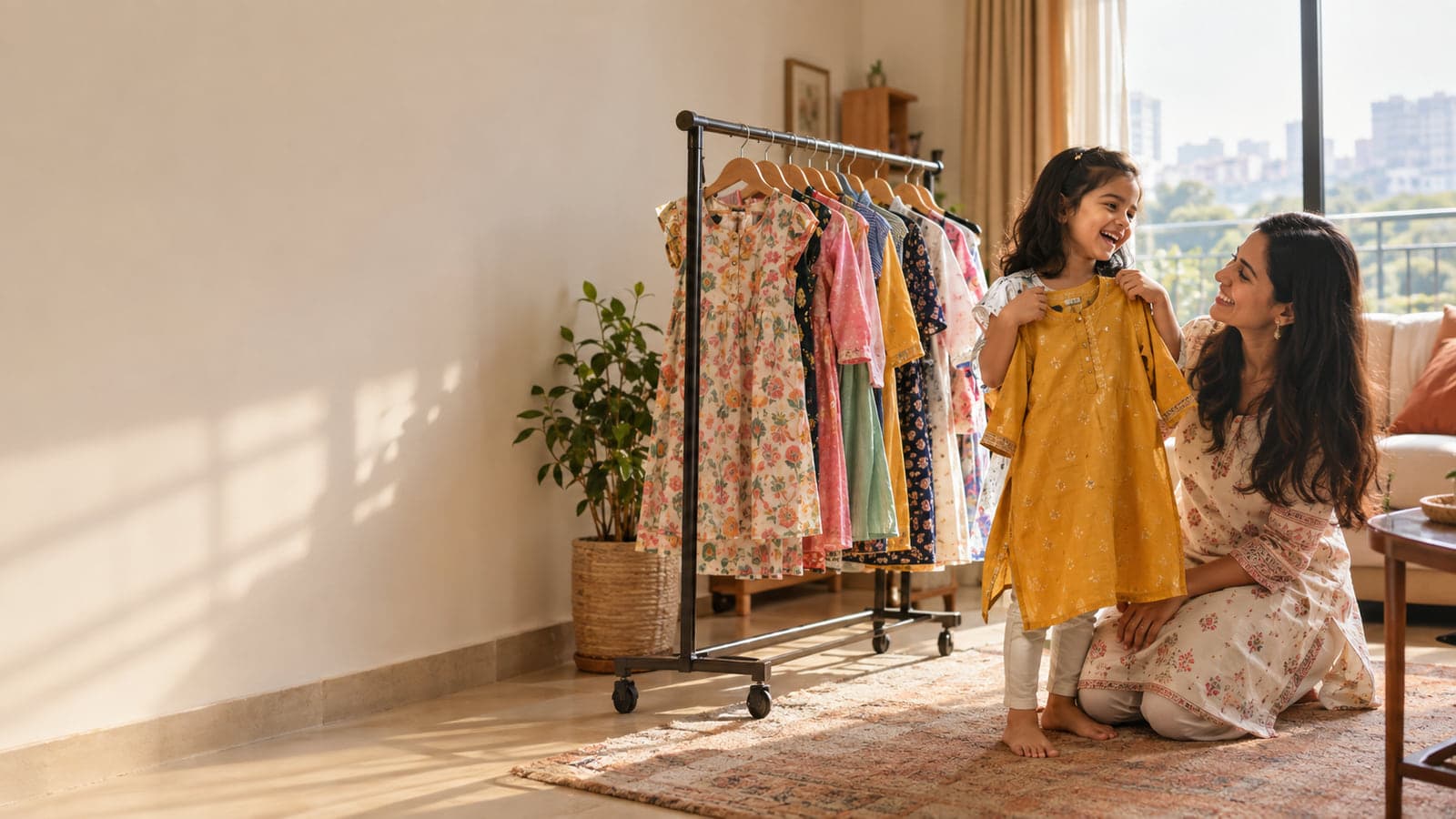
Imagine a Saturday morning. Instead of getting everyone dressed, finding parking, driving to the mall and spending the afternoon walking through stores, you are at home. A selection of children’s clothes arrives. Your child is already comfortable.
They try one outfit. Then another.
You notice something you wouldn’t have noticed in a photograph: that colour actually looks great on them.
Then another outfit. This one fits perfectly.
Then another. Nope — they hate the fabric.
And that’s useful information too. Because the goal isn’t to convince your child to like every outfit. The goal is to discover what actually works.
The Rise of More Intentional Kidswear Shopping
There is a broader shift happening in kids fashion. Parents are becoming more selective. Instead of simply buying more clothes, many are looking for pieces that are comfortable, versatile, durable and worth wearing repeatedly.
The kidswear conversation increasingly includes quality over quantity, breathable fabrics, relaxed silhouettes, versatile basics, sustainable materials and clothes that allow children to move freely.
That is an important shift. Because children don’t need miniature versions of adult wardrobes. They need clothes that survive childhood.
What Should You Look for When Buying Kids Clothes in Bangalore?
Here’s a simple checklist you can save before your next shopping trip.
- ComfortCan your child move, run and sit comfortably?
- FabricIs it breathable and suitable for the weather?
- FitIs it comfortable without being too tight or excessively oversized?
- DurabilityCan it survive regular washing and everyday play?
- VersatilityCan you combine it with other pieces?
- Child’s preferenceWould your child actually choose to wear it?
- OccasionDoes it have a clear purpose in the wardrobe?
- ValueWill it be worn enough to justify the purchase?
This sounds simple. But these eight questions can prevent a lot of unnecessary shopping.
Kids Fashion Doesn’t Have to Mean Following Every Trend
There’s always another trend. One month it’s oversized T-shirts. Then co-ord sets. Then retro sportswear. Then matching family outfits. Then something completely different.
Some children’s fashion trends are genuinely practical — relaxed silhouettes, comfortable co-ords, playful prints and breathable fabrics can make sense for everyday life. But parents don’t need to chase every trend.
A good rule: if the trend makes your child’s life more comfortable, consider it. If it only makes the wardrobe look more fashionable but makes the child uncomfortable, it’s probably not worth it.
And Then There Are the Big Occasions
Of course, children don’t live entirely in T-shirts and shorts. Bangalore families have plenty of reasons to dress up.
Birthdays. Weddings. Diwali.
Raksha Bandhan. Ganesh Chaturthi. Navratri.
Family functions. School events. Festive celebrations.
This is where kids party wear and kids ethnic wear become important. The challenge here is different. Parents want something special. Children want something comfortable. And nobody wants an outfit that looks beautiful for 20 minutes and becomes unbearable for the next three hours.
The best occasion wear finds the middle ground: looks special, feels comfortable.
A Smarter Way to Shop for Kids Clothes
So what does smarter kids clothing shopping actually mean? It doesn’t necessarily mean buying cheaper clothes. It doesn’t mean buying expensive brands. It doesn’t mean shopping online. And it doesn’t mean spending every weekend at a mall.
It means reducing uncertainty:
- Know your child’s current size.
- Understand their lifestyle.
- Buy for real occasions.
- Prioritise comfort.
- Choose versatile pieces.
- Think about cost per wear.
- And whenever possible, try before you buy.
The Future of Kids Clothing Shopping in Bangalore May Be Closer Than You Think
For a long time, shopping meant going somewhere. The store was the destination. But technology has changed that. Food comes home. Groceries come home. Furniture can be viewed virtually. And increasingly, experiences are being designed around the customer’s home.
Kidswear can work the same way. Instead of asking parents to find time to visit a store, why not make the store fit into the family’s schedule? That’s the idea behind home try-on for kids’ clothing.
You still get the most important part of physical shopping — the ability to see and try the clothes. But you remove much of the unnecessary effort around it.
What is home try-on for kids’ clothing?
Home try-on means the shop comes to you. With Skipzy in Bangalore, a stylist brings a curated rack of kids clothing to your home, your child tries everything on in their own space, and you pay only for the pieces you keep. The rest leaves with the stylist, so there is nothing to pack up or return.
So, What Is the Smarter Way to Shop?
Maybe the answer isn’t choosing between online shopping and shopping at a store. Maybe it’s taking the best parts of both: the discovery and convenience of online shopping, the confidence of trying clothes in person, and the comfort of being at home.
Because ultimately, kids’ clothing shopping isn’t really about clothes. It’s about time. It’s about convenience. It’s about avoiding unnecessary purchases. It’s about finding something your child feels good wearing. And, perhaps most importantly, it’s about making one small part of parenting a little easier.
So the next time you’re searching for “kids clothing shopping in Bangalore” or “kids clothes near me” or “best kids clothing stores in Bangalore”, pause for a second and ask yourself: do I really need to take my child shopping? Or can I bring the shopping experience to my child?
Sometimes, the smarter shopping trip is the one you don’t have to make.